 TR
 EN
 AR
 RU
 ZH
 DE
 FR
 ES
 HI
 FA
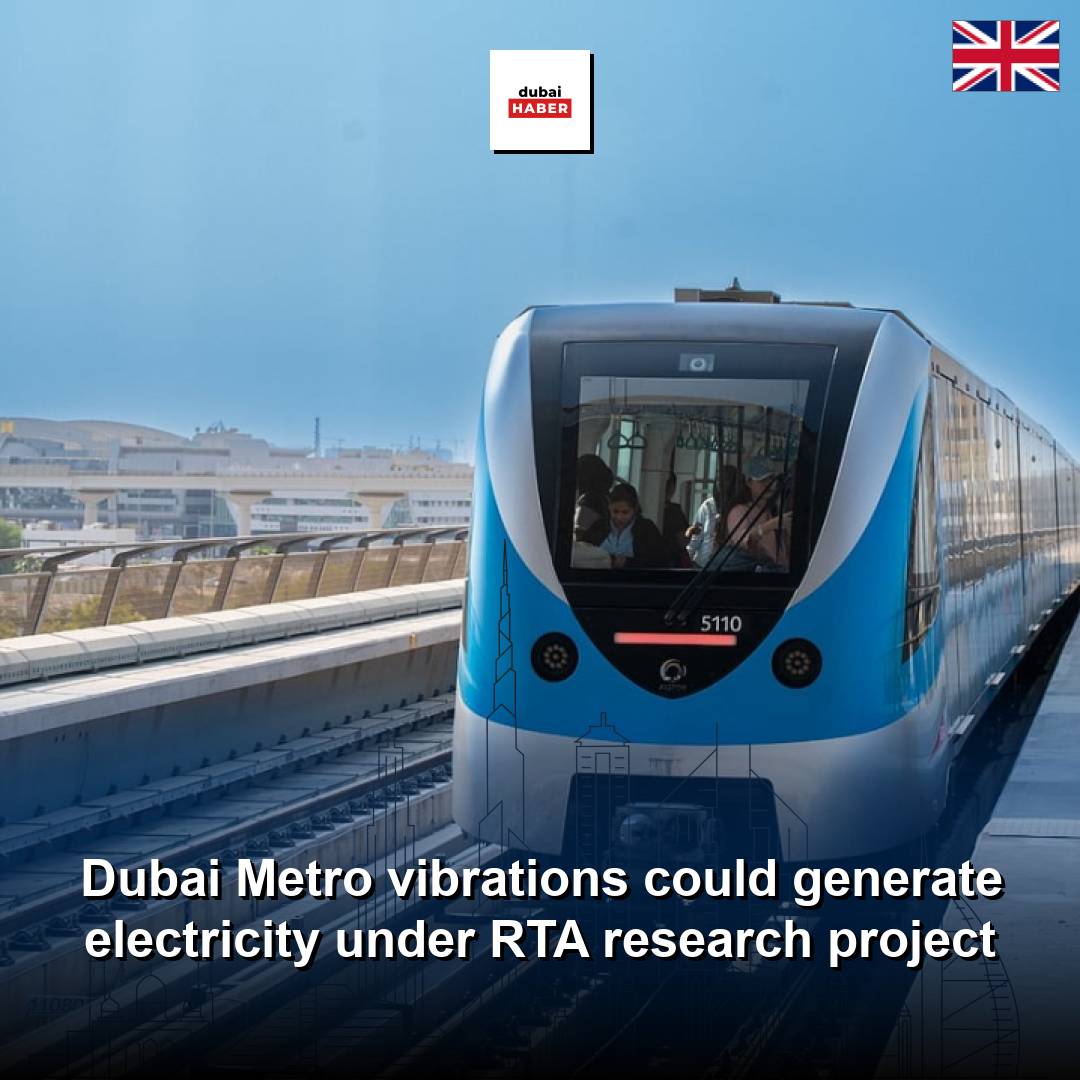
Vibrations from Dubai Metro's rail infrastructure could be used to generate electricity for monitoring equipment under a research project featured in the Roads and Transport Authority's (RTA) future transport roadmap.
The project, with Amity University Dubai, explores how energy from rail vibrations could support autonomous monitoring systems in Metro corridors. It is among the research initiatives highlighted during Dubai Future Week, where the authority also displayed a roadside wind-energy concept that could help power traffic lights.
Speaking to Khaleej Times, an RTA representative explained that the rail project would make use of vibrations to generate electricity.
The accompanying display describes the development of a desert-resilient piezoelectric system for autonomous monitoring in Dubai Metro corridors. The research targets energy for monitoring equipment, rather than the power supply for Metro trains.
The work forms part of the RTA's Research, Development and Innovation Strategy 2030, launched in October 2025. Its four pillars cover safety, future seamless mobility technologies, sustainability and operational excellence.
Another concept looks at capturing wind associated with passing vehicles through a device intended for the road right-of-way.
The exhibit, labelled "Vertaxis Clean Energy", showed a model of the device. Its display described urban wind power as suitable for locations beside roads, Metro corridors and rail tracks, including sites with low wind.
According to RTA Dubai this energy could be used to operate traffic lights or it could even go to the grid.
Energy generation is not the only focus of the RTA's university research collaborations. Several projects examine how roads and pedestrian routes could better cope with heat.
A project with the American University of Ras Al Khaimah explores a hybrid solar-energy and pavement-cooling system intended to harvest energy while reducing heat on Dubai roads.
New York University Abu Dhabi is listed on research into solar cooling and carbon-reducing pavements for sustainable urban infrastructure. A separate project involving Khalifa University and NYU Abu Dhabi examines how shaded routes to Metro stations could be optimised.
The roadmap also includes University of Wollongong in Dubai research into bio-luminescent road markings intended to improve nighttime visibility. Khalifa University is studying food-delivery data to understand urban consumption and its effect on transport mobility.
A separate RTA display focused on battery-swap stations for electric delivery motorcycles, aimed at supporting their adoption, cutting emissions and improving operating efficiency.
The exhibit identified the work with Terra as a 'Proof of Concept (PoC)', ahead of implementation and scale-up. Riders would exchange a depleted battery for a charged one instead of waiting for the same battery to recharge. No rollout date or number of planned stations was specified.
Another Khalifa University project focuses on developing a support and evaluation tool for high-power, quasi-dynamic wireless charging systems for public buses.
The RTA representative described the possibility of electric buses charging as they travel along a road.
(Source: Khaleej Times)